

Published: By Trucell7 min read
The $39,000 sticker shock: breaking the clinic server refresh cycle in 2026
Cloud migration for medical clinics: server refresh pricing has nearly tripled since 2020, shifting the economics for Bp Premier, Medical Director and Genie.
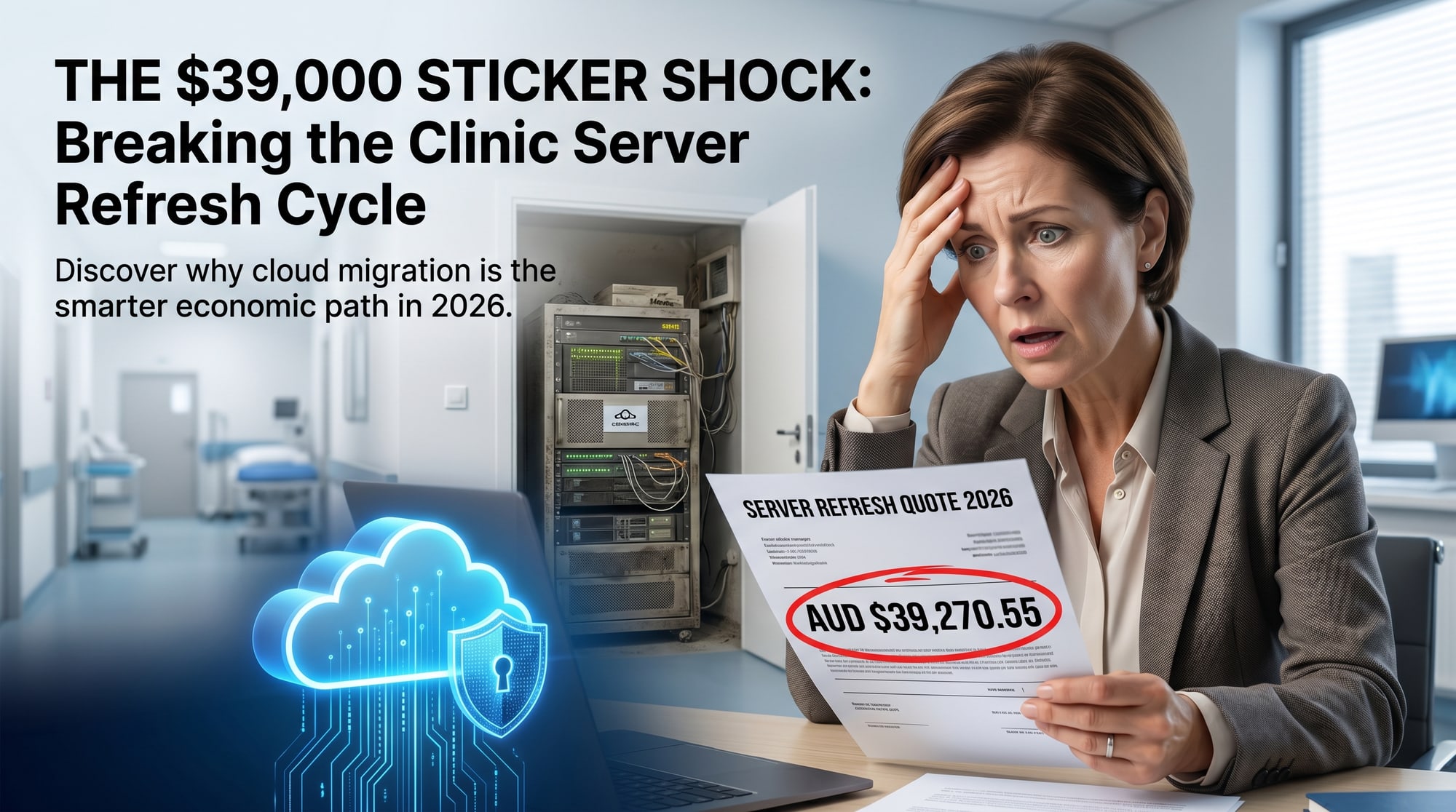
If your medical clinic bought a server in 2020 to run Bp Premier, Medical Director, or Genie Classic, you are now in refresh territory. Most clinics depreciate practice-server hardware on a five-year cycle, and warranty windows from Dell, HP, and Lenovo land in the same range. So the quotes for 2026 refresh capex are landing in inboxes right now.
Brace yourself. The number has changed.
The sticker shock, with real public numbers
Two illustrative quotes published publicly by GPsupport, a Melbourne-based supplier of GP-clinic IT services, make the point:
A 2020 quote for a Dell PowerEdge T440, single Intel Xeon Silver 4210 (10 cores), 64GB DDR4 ECC RAM, PERC H730P RAID, dual 1GbE: $13,845.98 inc GST.
A 2026 quote for a Dell PowerEdge T550, dual Intel Xeon Silver 4310 (12 cores each, 24 total), 128GB DDR4 ECC RAM (expandable), PERC H755 RAID, dual 10GbE SFP+: $39,270.55 inc GST.
That is a $25,424.57 jump, or roughly 2.84x the 2020 price.
GPsupport pricing sits at the upper end of the Australian GP-IT market and these numbers reflect that, so treat them as the high anchor rather than the cross-market average. The directional point holds regardless: server refresh capex for a clinic in 2026 is materially more than the same exercise was in 2020, even at sharper-priced suppliers.
Being honest about why
The clean “your server costs nearly three times what it did” headline is half the picture. The other half is that the 2026 quote is for a meaningfully bigger machine: two CPUs instead of one, double the RAM, and 10GbE networking instead of 1GbE. That spec uplift is not vendor padding. It reflects the reality that the current generation of GP practice software runs hotter than the 2020 generation: more concurrent users, more integrations, more reporting and AI workload, more cloud-sync overhead, longer expected service life under heavier load.
So two things are simultaneously true:
- Hardware spec for clinical workloads has roughly doubled in five years. Vendors won’t quote a 2020-equivalent T440 with 64GB for a 2026 practice; it will not carry the load comfortably over its 2026-to-2031 service life.
- Per-component prices have also genuinely jumped. RAM is the headline: DDR4 ECC prices have roughly doubled since 2024, driven by AI training infrastructure consuming most of the world’s memory supply. CPU and storage prices are also up. AUD weakness against USD compounds it on import. Geopolitical supply-chain pressure (Taiwan, US tariffs, fab capacity constraints) adds another layer.
Both effects stack. You get a bigger machine because you have to, and each component in that bigger machine costs more than it would have at any point in the last decade. The result is the $39,270.55 quote.
What this means for your five-year cycle
A medical clinic that signs the $39,270 quote in 2026 is committing to:
- $39,270 capital outlay in 2026, plus installation, migration, and downtime.
- Five years of on-premises operation, with hardware risk, backup ownership, patching, monitoring, ransomware exposure, and the on-call burden on whoever runs your IT.
- Another refresh quote in 2031, which on current trends will land somewhere north of $50,000.
That is a $90,000+ commitment to on-premises hardware over the next decade, ignoring the running costs of power, cooling, internet, UPS replacement, and the staff time that goes into looking after a physical server in a clinic.
For a single-site GP practice with eight to fifteen workstations, that money has alternative uses.
The cloud alternative
The honest case for cloud is not “cloud is always cheaper”. Sometimes it is, sometimes it isn’t. The honest case for cloud in 2026 for medical clinics running server-based practice software is that the capital cycle has broken in a way that changes the maths.
Trucell Private Cloud is our managed cloud service for Australian organisations. For medical clinics specifically, what it does is:
- Runs Bp Premier, Medical Director, Genie Classic, and most other server-based practice management systems as if they were on a clinic server, but the server lives in a Trucell-managed environment instead of your reception cupboard.
- Sized to your concurrency requirements, scaled up or down as your practice grows or contracts.
- Backed up daily with retention you can defend in a clinical audit, encrypted in transit and at rest.
- Managed under our ISO 9001 and ISO 27001:2022 certified management systems, with an annual SOC 2 Type II report available under NDA.
- No five-year refresh cycle. The infrastructure under your environment is refreshed by Trucell on our schedule, not your capex calendar.
The relevant comparison is not “is the monthly fee less than the server depreciation per month”. The relevant comparison is “do I want to be the clinic that owns and operates clinical infrastructure in 2026, with all the security, backup, ransomware, and refresh-cycle accountability that comes with that, or do I want that accountability to sit with a specialist provider who carries audited certifications for the work.”
For pricing specific to your practice, we will quote on request based on your concurrency, integrations, retention requirements, and any geographic data-residency constraints.
Already on Gentu, Clinic to Cloud, Bp SaaS, or Helix?
This article is primarily for practices running server-based clinical software. If you are already on Gentu, Clinic to Cloud, Bp SaaS, or Medical Director Helix, the 2026 server refresh quote is not the conversation you are having. The one you might be having instead is the monthly vendor-hosting bill.
We hear it consistently. Vendor-hosted SaaS subscriptions for clinical practice management have crept upward over the last few cycles, the per-user pricing scales aggressively as a practice grows, and the cost over a five-year horizon for a mid-sized clinic is now landing in territory that some practices feel deserves a second look.
For Bp SaaS and Medical Director Helix customers, there is a concrete alternative worth scoping: running the server version (Bp Premier or Medical Director) inside Trucell Private Cloud. Same clinical software your team already uses, hosted under Trucell’s audited environment, often at lower monthly cost than the vendor’s own hosted subscription depending on practice size and concurrency. The migration is real work, but for some practices the maths is compelling.
For Gentu and Clinic to Cloud customers, the software is cloud-only by design, so there is no server version to lift into our private cloud. The cost question runs differently: typically it is about the adjacent IT spend (workstations, identity, backup, security, peripherals) rather than the hosting subscription itself, where Trucell can usually find sensible savings without changing your core practice management platform.
If your monthly vendor-hosting bill has crept past what feels proportionate to the size of your practice, that is a conversation worth having alongside (or instead of) the refresh-vs-cloud conversation this article is about.
Migration path, in plain terms
If you decide to migrate rather than refresh, a typical Trucell Private Cloud migration for a single-site clinic runs roughly:
- Scope and assessment: current server, software versions, integrations, data volume, retention requirements, identity, backup posture.
- Build: provision the equivalent environment in Trucell Private Cloud, install practice software, restore a working copy of your database for testing.
- Test cutover: run your software in the cloud environment in parallel for a defined period, with a known-good rollback path.
- Production cutover: scheduled at a low-clinical-activity window. Practical downtime is usually a few hours, not days.
- Decommission and asset disposal: the old server is wiped to standard, removed, and the cupboard space goes back to general use.
Most single-site clinic migrations complete within four to eight weeks from kickoff. Larger multi-site groups (see our multi-site clinics solution page for context) plan for longer windows and phased cutovers.
Talk to us
If your 2026 server refresh quote has just landed, before you sign it, send us the spec and let us scope the cloud-migration alternative against it. We will give you an honest answer about whether cloud, refresh, or SaaS migration is the right call for your practice. Use the form below to start the conversation.
Related reading
- How to check if your radiology display is still meeting brightness standards (free test kit)
- Quality and security, audited together: Trucell is now ISO 9001:2015 and ISO 27001:2022 certified
- Trucell is ISO 27001:2022 certified for managed IT services, with specializations in PACS/RIS and DICOM
- IT strategy and the virtual CTO